Adaptive Learning for the Business Analyst: Bridging the Health IT Complexity Gap
Standard static training - reading a PDF or watching a generic video - is no longer enough to navigate modern interoperability challenges. The solution is adaptive learning, a personalized approach that transforms the way BAs master HL7, FHIR, and EHR integrations.
2/17/20262 min temps de lecture
Adaptive Learning for the Business Analyst: Bridging the Health IT Complexity Gap
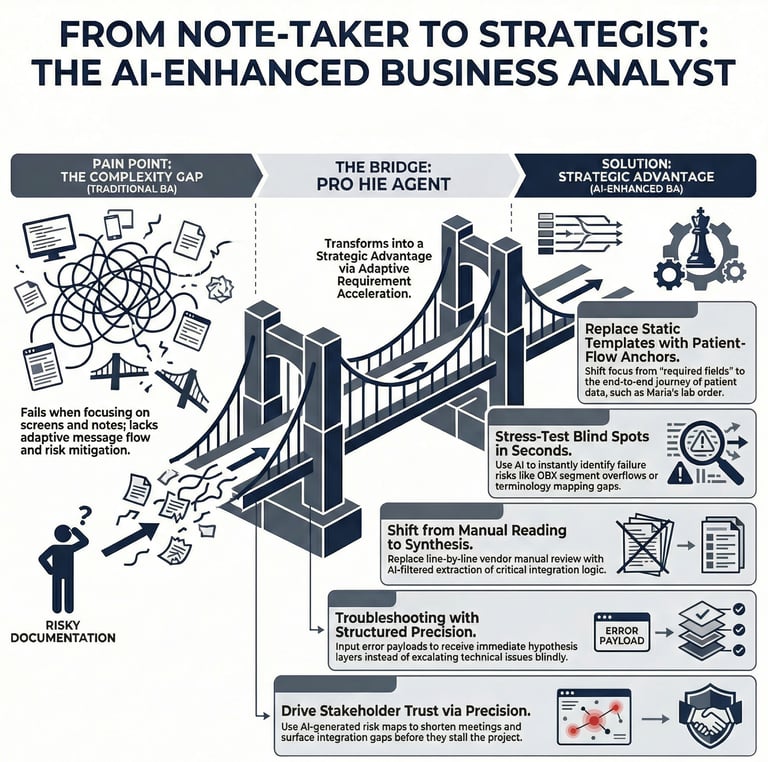
In the high-stakes world of Health Information Exchange (HIE), the distance between theoretical knowledge and real-world execution is known as the “Complexity Gap”. For the Business Analyst (BA), this gap is often filled with tangled data flows, ambiguous stakeholder requirements, and the constant pressure of a looming Go-Live.
Standard static training—reading a PDF or watching a generic video—is no longer enough to navigate modern interoperability challenges. The solution is adaptive learning, a personalized approach that transforms the way BAs master HL7, FHIR, and EHR integrations.
Why Static Training Fails the Modern BA
Business Analysts in Health IT face a unique set of "pains":
The Blank Page Syndrome: Overwhelmed by the need to write technical specifications, mappings, and test cases from scratch.
Fear of Inexperience: The anxiety of sounding underqualified in meetings with seasoned developers or vendors.
Missing Critical Steps: The risk of overlooking a vital clinical workflow detail that could stall a project.
Adaptive learning addresses these by serving as an always-on Health IT coach that matches course knowledge to your specific job tasks.
4 Ways Adaptive Learning Accelerates the BA Career
1. From Blank Page to Polished Draft
The most significant ROI of an adaptive platform like the PRO HIE Mentor is the Document Accelerator. Instead of starting from zero, the system acts as a "Socratic" writer. It asks you targeted questions about your project—such as whether an interface is unidirectional or bidirectional—and produces a structured, professional specification in minutes.
2. Tracing the Patient Data Journey
Understanding how data moves from System A to System B is foundational to requirements gathering. Adaptive learning uses a "hop-by-hop" explanation model.
Example: For Maria’s patient journey, you can trace her glucose result as it moves from the Laboratory Information System (LIS), through the Interface Engine for mapping, and finally into the EHR for provider viewing.
3. Decoding Standards in Plain Language
HL7 v2 segments and FHIR resources can read like gibberish. An adaptive mentor allows you to ask granular questions at your own level of understanding.
Scenario: If you are unsure what OBX-5 represents in a message, the mentor explains it is the "Observation Value" field—the actual result of Maria’s test.
4. Personalized Project Coaching
No two Health IT projects are identical. Adaptive learning adjusts its guidance based on your specific background and job title. Whether you are a new analyst on an imaging project or a senior lead managing consent logic, the system helps you build a prioritized action plan.
The Strategic Advantage: Clarity and Competence
For the Business Analyst, moving to an adaptive learning model provides three core benefits:
Clarity: Ends confusion over complex data flows and demystifies standards like HL7 and FHIR.
Confidence: Eliminates the fear of sounding inexperienced and equips you to ask the right questions of stakeholders.
Competence: Prevents missed steps in project planning and accelerates the delivery of high-quality documentation.
Adaptive learning doesn't just teach you about the "Maria Patient Journey"—it gives you the tools to manage your own.
Ready to bridge the Complexity Gap? Visit HealthInformaticsAcademy.com to access the PRO HIE Course Companion and start your personalized learning journey today.