
Maria Was Admitted, But the Viewer Was Blank: What Health IT Professionals Need to Know
Maria was admitted and the ADT message may have fired, but her data still did not show in the clinical viewer. Learn the real-world downstream causes and how Health IT professionals should investigate.
3/9/20262 min temps de lecture
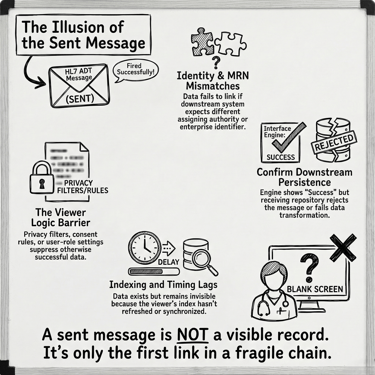
Why Maria’s Data Did Not Show in the Clinical Viewer After Admission
Maria arrives at the hospital and is admitted through the registration workflow. The source EHR creates the patient encounter and triggers an HL7 ADT message. On paper, everything looks correct.
But when the clinician opens the clinical viewer, Maria’s information is missing.
This is a classic interoperability learning moment because it shows the difference between a message event and a successful downstream outcome.
Why This Confuses So Many Professionals
Many professionals are taught the transaction, not the chain.
They learn:
ADT means admission
message sent means success
clinical systems are connected
But real interoperability work requires understanding what happens after the message leaves the source.
Maria’s End-to-End Flow
Walk through the flow:
Maria is registered
ADT^A01 is created
Interface engine receives message
Downstream consumer or repository processes it
Patient identity is resolved
Viewer index/search layer is updated
Clinician attempts retrieval
Where the Failure Could Be
1. Identity mismatch
Maria’s MRN may not align with the viewer’s expected patient identity structure.
2. Assigning authority issue
The message includes an identifier, but not in the format needed downstream.
3. Processing failure after interface success
The interface engine may show delivery success while the repository fails later.
4. Viewer indexing delay
The record exists, but the viewer has not refreshed or surfaced it.
5. Consent or policy suppression
The record may be intentionally hidden due to privacy rules.
6. Encounter context mismatch
The viewer may require visit-specific context the message did not support correctly.
7. Additional dependency missing
Sometimes ADT alone is not enough. The viewer may depend on other synced data elements or repository events.
The Questions an Analyst Should Ask
What was the source event?
What exact message was sent?
Was Maria identified correctly across systems?
Did the downstream repository persist the data?
How does the viewer retrieve and display records?
Are there caching, indexing, or refresh delays?
Are there policy rules affecting visibility?
What assumptions were made that were never validated?
The real skill is not memorizing HL7 segments.
The real skill is learning how to trace patient data from creation to consumption.
That is what helps professionals become confident in technical meetings, stronger in requirements conversations, and more useful on interoperability projects.
Maria’s missing viewer record is not just a technical problem. It is a teaching moment.
It shows why Health IT professionals need to understand the entire ecosystem: workflow, messages, identity, repositories, viewer logic, and policy rules.
That is exactly the kind of end-to-end thinking I teach in my course, using Maria’s journey to make complex interoperability practical and real.
If you want the full picture PLUS a more interactive way to learn, my AI agent can guide you through scenarios like this step by step: Explore Maria's Journey
This AI agent will help you think through CURRENT and FUTURE projects by asking you questions and providing responses to challenge your thinking = technical career growth!!