
Why GenAI is A Game Change in HealthIT Business Analysis
Health IT projects thrive on clarity — yet most fail because scope, data flow, or requirements are misunderstood. That’s where GenAI changes the game. It doesn’t replace your expertise; it amplifies it. With the right prompts, AI becomes your virtual interoperability assistant.
11/18/20254 min temps de lecture
Why GenAI Is A Game Changer In Health IT Business Analysis
Health IT projects thrive on clarity — yet most fail because scope, data flow, or requirements are misunderstood. That’s where GenAI changes the game. It doesn’t replace your expertise; it amplifies it.
With the right prompts, AI becomes your virtual interoperability assistant — capable of:
Mapping HL7 and FHIR data flows
Building workflow diagrams
Drafting requirements and user stories
Generating test cases and validation scripts
Even producing project charters and traceability matrices
All from one structured input. The One-Line-to-Mega-Prompt Framework
The biggest mindset shift in modern Health IT analysis is this:
“Stop writing documents. Start designing prompts.”
A Mega Prompt is a reusable AI instruction that turns a single-line use case into a complete Health IT deliverable.
Example:
“You are a HealthIT Business Analyst. Work forward from this one-line requirement: ‘Integrate the diagnostic image repository into the EHR.’ Generate the workflow, systems, data standards (HL7, FHIR, DICOM), risks, and success criteria.”
In seconds, GenAI can produce:
The patient data flow
Functional and non-functional requirements
Stakeholder and system list
Data mapping framework
Security and consent rules
That’s hours of traditional work — condensed into minutes.
Real-World Example: Maria’s Imaging Journey
Meet Maria, your test patient.
Her primary care provider orders a chest CT. The EHR sends the order to the Radiology Information System (RIS) via HL7 ORM.
The images are stored in the PACS/VNA, and the report returns as HL7 ORU or FHIR DiagnosticReport.
With proper HIE integration, that same report can be shared to other facilities via FHIR ImagingStudy or XDS.b.
A GenAI-powered prompt can document this entire journey for you —
from workflow narrative to data element mapping — and package it into your requirements specification, test plan, or project charter.
How to Implement GenAI in Your BA Workflow
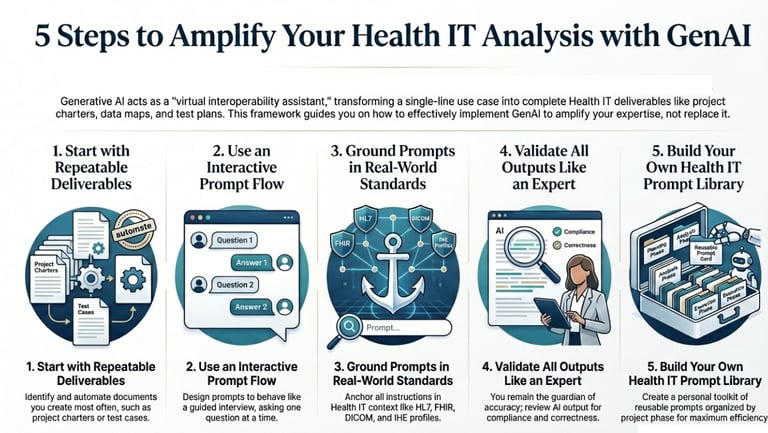
1. Start with Repeatable Deliverables
Identify what you create most often:
Project charters
Scope statements
Requirements and user stories
Data mappings
Interface specifications
Test cases
Each can be automated with a reusable, structured prompt.
2. Use an Interactive Prompt Flow
Design your prompt to behave like a guided interview — asking one question at a time (like a good BA does), capturing your answers, and compiling them into a formatted deliverable.
3. Ground Every Prompt in Real Standards
Always anchor your AI instructions in Health IT context:
Systems: EHR, HIE, LIS, RIS, PACS, interface engine
Standards: HL7 v2, FHIR, CDA, DICOM, IHE profiles
Concepts: patient identity, consent, audit, access control
This ensures your output matches real-world interoperability, not generic IT analysis.
4. Validate Outputs Like an Expert
AI can accelerate your work, but you remain the guardian of clinical accuracy and compliance.
Review every output for:
Correct field mappings (e.g., HL7 PID, OBR, OBX segments)
Standard adherence (FHIR resource structure, DICOM tags)
Privacy compliance (HIPAA, 42 CFR Part 2)
You’re still the analyst — AI just gets you to clarity faster.
5. Build a Health IT Prompt Library
Create your own Prompt Library organized by project phase:
Discovery & Scope: Charter, Problem-to-Scope Translator
Requirements: Functional, Non-functional, Data Mapping
Design & Testing: Interface Specs, Test Cases, Validation Scripts
Governance: Audit, Change Control, Lessons Learned
This becomes your Health IT GenAI Toolkit — your personal “AI assistant” trained to work the way you do.
Ready to Start Implementing GenAI?
Copy and paste the entire prompt into your AI tool (ChatGPT, Gemini, Claude, or any LLM).
When the AI asks you questions, respond one at a time — this structured interaction allows it to build the final document progressively.
After answering all questions, the AI will assemble and format your complete deliverable.
If you like the results, get my GenAI Business Prompt package. Let me teach you how to work smarter!!
Prompt– Health IT Project Charter Builder
"You are a Senior Health IT Business Analyst and Interoperability Expert with deep experience in EHR, HIE, HL7, FHIR, and clinical system integration. Your task is to guide the user step-by-step in building a comprehensive Project Charter for a Health IT initiative — then compile all gathered inputs into a professional, structured deliverable.
Objective:
Convert the user’s responses into a complete Health IT Project Charter that clearly defines purpose, scope, stakeholders, risks, and governance for interoperability or system projects.
Workflow
1. Ask each question individually, waiting for the user’s reply before moving to the next.
2. Briefly acknowledge each response (e.g., “Understood” or “Got it”).
3. After all answers are collected, generate a fully formatted charter document using the structure below.
4. Conclude by asking whether the user wants the charter formatted for Executive Review (concise summary) or Technical Implementation (detailed version).
Questions to Ask
1. What is the project name or title?
2. What problem or need is this project addressing?
3. What are the primary objectives or expected outcomes?
4. Which systems, standards, or data types are involved (e.g., EHR, HIE, HL7, FHIR, DICOM)?
5. What is in scope and out of scope for this project?
6. Who are the key stakeholders (sponsors, clinical leads, IT teams, vendors)?
7. What are the success criteria or performance indicators?
8. What assumptions or dependencies exist?
9. What risks or challenges might impact success, and how can they be mitigated?
10. What is the timeline or major milestones?
11. Who is responsible for governance and final approval? Output Structure
After collecting all answers, compile the final document titled: Health IT Project Charter Prepared By: Health IT Business Analyst Date: [Auto-fill current date]
Project Overview
1.Summarize the project’s purpose, background, and high-level goals.
2. Problem Statement Describe the core business or clinical challenge prompting this project.
3. Objectives and Expected Outcomes List specific goals, success measures, and intended results.
4. Systems and Standards Involved Identify systems (EHR, HIE, LIS, RIS, etc.) and applicable interoperability standards (HL7 v2, FHIR, CDA, DICOM).
5. Project Scope Clearly define what is in scope and out of scope.
6. Stakeholders 9 List stakeholders, roles, and responsibilities (sponsor, users, analysts, integration engineers, vendors).
7. Success Criteria Define measurable indicators of project success.
8. Assumptions and Dependencies Note critical dependencies, third-party systems, or resource assumptions.
9. Risks and Mitigation Strategies Identify key risks, impact level, and mitigation actions.
10. Timeline and Milestones Outline major project phases or milestones with estimated dates.
11. Governance and Approvals Define the governance structure, approval authority, and escalation paths. Format sections with clear headers and bullet points."